OrderThe Christian moral order
He Chose Capture Over Escape. Father Kapaun Shows What Faith Costs.
An Army chaplain stayed with the wounded, kept Easter in a prison camp, and is still on the road to sainthood.

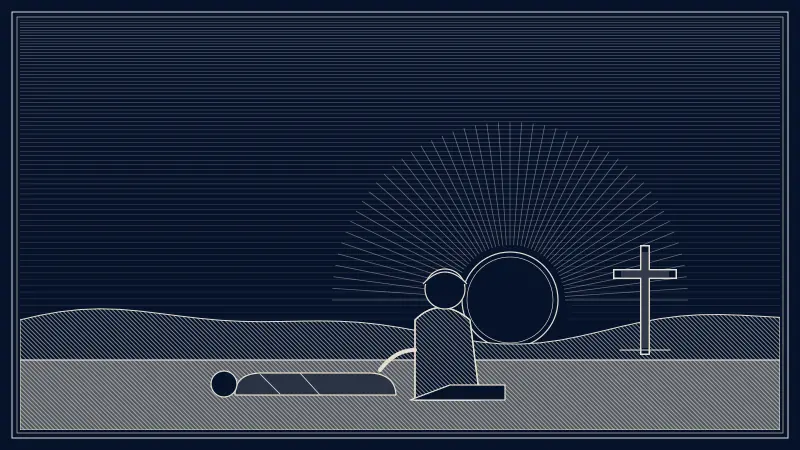
In early November 1950, near Unsan, Korea, a surrounded American battalion was told to pull out. The able-bodied men were ordered to evacuate. The battalion’s chaplain stayed. The Army’s Medal of Honor citation (opens in a new tab) says Chaplain Emil Kapaun, “fully aware of his certain capture, elected to stay behind with the wounded.”
He was a priest from Pilsen, Kansas, born in 1916. He died in a prison camp at 35. Here is what he did, and what I think it asks of the rest of us.
What he did at Unsan
The Army’s account (opens in a new tab) is specific. Kapaun moved from foxhole to foxhole under fire. He crawled out to wounded men and dragged them back, or dug shallow trenches to shield the ones he couldn’t move. He turned down several chances to escape. When Chinese infantry closed in on the dugout where wounded Americans lay, he convinced a wounded Chinese officer to negotiate for their safety.
Shortly after his capture, a Chinese soldier was about to execute Herbert Miller, an American lying in a ditch with a broken ankle. Kapaun pushed the soldier aside and hoisted Miller to his feet. Then he carried and supported him for several days on the march north.
What he did in the camps
At a camp called Sambukol, malnutrition was causing pellagra and beriberi. The Army says Kapaun dodged guards after dark to steal extra rations, which he “distributed evenly among the prisoners.” When the men were moved back to Pyoktong in January 1951, prisoners began to die “by the hundreds.” He kept sneaking around the camp at night, foraging for food and caring for the sick. On at least one occasion he was caught and punished by being forced to sit outside in subzero weather without any garments.
President Obama, presenting the medal in 2013, added details (opens in a new tab): Kapaun pounded metal into pots to boil clean water, and he talked hungry men who were hoarding food into sharing it.
Then the camp turned on the one thing he couldn’t give up. In March 1951 the Chinese began a mandatory re-education program meant to make prisoners “renounce the war, reject their religious beliefs and embrace communism.” The Army says Kapaun “patiently and politely rejected every theory put forth by the Chinese instructors.” Later that month he “openly flouted” the ban on religious services by conducting a sunrise service on Easter morning, 1951. Obama said the prisoners who sang the Lord’s Prayer and “America the Beautiful” with him were “men of different faith, perhaps some men of no faith.”
His body gave out. Over the protests of his fellow prisoners, the Chinese moved him to what the Army calls a “filthy, unheated hospital,” where he died alone. As he was carried there, the Army says, he asked God’s forgiveness for his captors and made his fellow prisoners promise to keep their faith. The date was May 23, 1951.
Why this is ordered liberty
That camp shows what a state does when it decides conscience belongs to it. The re-education program was built to strip out religion along with support for the war. Kapaun didn’t answer with a speech or a plot. He answered one theory at a time, politely, and then with an Easter service.
That’s what I mean by ordered liberty. It isn’t the right to be left alone while nothing is asked of you. It is a freedom that rests on something above the state: a duty to God and to the man next to you. It holds only when people are willing to pay for it. By any normal measure Kapaun had no freedom left. He acted like a free man anyway, because every day he chose who he would serve.
I am not saying America is a prison camp. It isn’t, and I won’t pretend otherwise. My point is smaller. Habits like his are cheap to practice in a free country and impossible to improvise in a camp. Notice, too, what the Army says he did on the way to that hospital: he asked God’s forgiveness for his captors. You can hold a line without hating anyone. That is the standard I want for this site.
Where his story stands today
For decades his body was lost. In 2013 Obama said Kapaun’s remains were “unrecovered to this day.” That has changed. According to the Defense POW/MIA Accounting Agency (opens in a new tab), his remains had been buried in a grave marked “unknown” in Honolulu in 1956 and were disinterred in 2019. The agency announced the identification in May 2021. After a funeral on September 29, 2021, he was laid to rest at the Cathedral of the Immaculate Conception in Wichita, where the faithful can visit (opens in a new tab).
The Church’s process is slower. He was named a Servant of God in 1993. On February 24, 2025, Pope Francis authorized the Dicastery for the Causes of Saints to promulgate the decree (opens in a new tab) on his “offering of life,” and the Diocese of Wichita says (opens in a new tab) that makes him Venerable. As of today, October 23, 2026, that is where it stands. I found no announcement of a beatification. That step needs one miracle approved by the Church, and the diocese says the review “will likely take many years.” Stars and Stripes reported (opens in a new tab) in May that, pending the Vatican’s findings, he could become the first U.S. military service member declared a saint. That is a possibility, not a decision.
What to do with it
Read the Army’s account once, start to finish. It’s short. Then hand it to one person under thirty.
This week, find one person who is carrying something alone, such as a widowed neighbor, a veteran, or a new parent, and carry part of it. And the next time you’re pushed to say something you don’t believe, say no politely and keep your temper. That is a small version of what he did every day.
Most of us will never be asked to stay behind with the wounded. All of us will be asked, in small ways, whether we would.
Sources
- U.S. Army, Medal of Honor citation for Chaplain (Capt.) Emil J. Kapaun (April 11, 2013) (opens in a new tab)
- U.S. Army, Medal of Honor narrative: Chaplain (Capt.) Emil J. Kapaun (April 11, 2013) (opens in a new tab)
- President Obama, remarks at the Medal of Honor presentation to Chaplain Kapaun (April 11, 2013) (opens in a new tab)
- U.S. Department of War (DPAA Public Affairs), Chaplain Emil J. Kapaun: ‘Padre’ Finally Returns Home (Sept. 30, 2021) (opens in a new tab)
- Diocese of Wichita and the Kapaun cause, Kapaun Comes Home (2021 funeral and burial) (opens in a new tab)
- Holy See Press Office, Promulgation of Decrees of the Dicastery for the Causes of Saints (Feb. 25, 2025) (opens in a new tab)
- Father Kapaun's cause for sainthood (frkapaun.org), steps and current status (opens in a new tab)
- Stars and Stripes, “He died in a Korean War prison camp. Now Emil Kapaun could become the US military’s first saint” (May 22, 2026) (opens in a new tab)
The video excerpts above are from U.S. government video: DVIDS, Chaplain (Capt.) Emil Kapaun’s Remains Return to Wichita, Ks. (opens in a new tab), DVIDS, Medal of Honor Recipient Remembered by Fellow POWs (opens in a new tab), and the White House archive video of the April 11, 2013 Medal of Honor presentation (opens in a new tab).
The appearance of U.S. Department of War (DoW) visual information does not imply or constitute DoW endorsement.
Keep Reading
All stories Order
They Said Church Was Dying. Young Americans Didn’t Get the Memo.
For basically my whole adult life, I’ve been told the same story. Church is dying. Young people are leaving and never coming back. Give it a generation and Christianity in America will be a… Order
Pro-Life Isn’t One Issue. It’s Every Person, at Every Stage.
I get asked a lot why I talk about life so much on a blog that also talks about manufacturing and reactors. Fair question. My answer is simple: none of the rest of it matters if we don’t… Order